
Are you Specifying Stainless Steel Woven Mesh? Here’s What you Need to know
Stainless steel woven mesh is available in many combinations of aperture, wire diameter, mesh count, stainless steel grade and weave. Knowing how these characteristics relate to each other makes it easier to identify an existing mesh or specify the most appropriate woven mesh for your project.
At its simplest, woven wire can be identified and specified using a combination of aperture or mesh count and wire diameter. Other information, including stainless steel grade, weave, dimensions and the application’s requirements, can then be added to create a more useful specification. SSWM’s Woven mesh product page, Stock Guide and Technical Data Sheets specifically identifies aperture or mesh count together with wire diameter as the basis for specifying woven wire.

Quick answer
To specify stainless steel woven mesh, start by establishing the aperture or mesh count and wire diameter. Then identify the required stainless steel grade, weave and roll or sheet dimensions as appropriate. For some applications, percentage open area and micron size may also be important.
SSWM’s woven mesh range is presented using mesh count, SWG, aperture, wire diameter and approximate percentage open area, illustrating why a complete specification involves more than simply asking for a particular “mesh size”.
What Information Should Be Included in a Woven Mesh Specification?
There are several characteristics used to describe stainless steel woven wire mesh.

Aperture
Aperture is the opening between two adjacent wires. SSWM expresses aperture in millimetres.
Aperture is particularly important when the mesh needs to control the size of material, particles or objects that can pass through an opening.
When aperture is the critical requirement, state the required opening rather than relying on mesh count alone.
Wire diameter
Wire diameter is the thickness of the wire before weaving.
Two woven meshes can have the same mesh count but use different wire diameters. Changing wire diameter changes the resulting aperture and percentage open area, so wire diameter should be stated alongside mesh count or aperture.
Mesh count
Mesh refers to the number of openings per lineal inch.
For example, 10 openings each way per lineal inch is known as 10 mesh, while 40 openings per lineal inch each way is known as 40 mesh.
This is one reason a description such as “6 mesh” may not provide enough information by itself. Wire diameter is also necessary to understand the resulting opening.
Stainless steel grade
Material grade should form part of the specification rather than simply describing the product as “stainless steel mesh”.
SSWM woven mesh range is stocked in grades 304 and 316. Specials are also available in grades 316L and 2507. Individual product availability should be checked against the required mesh specification rather than assuming every mesh configuration is available in every grade.
Weave
Weave
The weave describes how the longitudinal and transverse wires are arranged.
SSWM stocks four weave types for woven mes: plain weave, intercrimp, lock crimp and twill weave.
Plain weave
Plain weave is the most common and simplest weave. Each warp wire passes alternately over and under the wires running transversely through the cloth at 90 degrees.

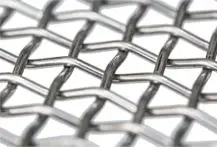
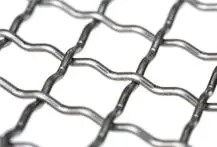
Intercrimp weave
Intercrimp mesh incorporates additional crimps in the warp and weft wires between intersections.

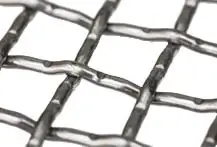
Lock crimp weave
Lock crimp is made using pre-crimped wire and is stabilised by a notch or bump at the wire intersections.

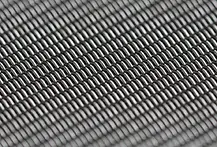
Twill weave
SSWM describes twill weave as being produced by passing each fill wire alternately over and under two warp wires.
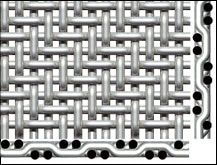
Is Produced by passing each fill wire alternatively over and under two warp wires.
The appropriate weave should therefore be identified when it is relevant to the
required mesh construction.
What Do Warp, Weft and Pitch Mean?
Understanding woven mesh terminology can make technical drawings, data sheets and enquiries much easier to interpret.
Warp wires run parallel to the length of the woven cloth, while weft wires run across the cloth as woven. Pithc is the distance between the middle points of two adjacent wires, or the sum of aperture width and wire diameter.
When woven cloth has different characteristics in each direction, state the warp mesh and wire before the weft mesh and wire in the specification.
These distinctions become particularly important when the construction is not identical in both directions.
How Do You Calculate the Aperture of Woven Mesh?
If you have a piece of woven mesh but do not know its aperture, it can be measured.
Calculating the aperture1. Count a convenient number of apertures, N.
2. Measure the length covered by those apertures, L.
3. Measure the wire diameter, D.
4. Calculate the average aperture, A.
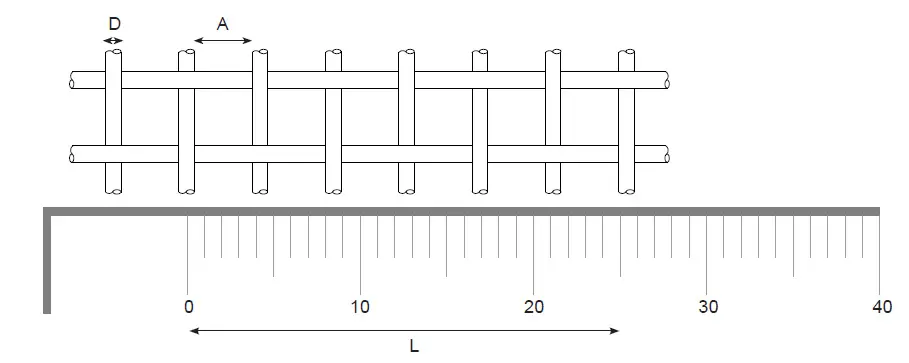
1. A working example of calculating the aperture of 6/20 woven wire mesh:
The formula is:
A = (L ÷ N) − D
A working example:
- Number of apertures counted: 6
- Length measured centre-to-centre: 25.4 mm
- Wire diameter: 0.9 mm
Therefore:
A = (25.4 ÷ 6) − 0.9
A = 3.33 mm
The woven wire is identified as 3.33 mm aperture / 0.9 mm diameter.
This approach is useful when identifying an existing mesh because measuring across several apertures can provide a practical basis for determining the average opening rather than attempting to measure a single opening.
How Is Mesh Count Calculated?
Once aperture and wire diameter are known, the following calculation can be applied to determine mesh count:
Mesh = 25.4 ÷ (D + A)
Using the same example:
Mesh = 25.4 ÷ (0.9 + 3.33)
Mesh = 6 mesh
This corresponds with the 3.33 mm aperture and 0.9 mm diameter example above.
The relationship demonstrates an important specification principle: mesh count, aperture and wire diameter are connected. A mesh count on its own does not fully describe the woven wire.
What Is Percentage Open Area?
Where:
• A = aperture
• D = wire diameter
Using SSWM’s 3.33 mm aperture / 0.9 mm wire example produces an approximate open area of 62%.
Open area can therefore add another useful characteristic to a mesh specification where the proportion of unobstructed opening matters to the application.
What Does Micron Mean in Woven Mesh?
For finer mesh, aperture may also be described in microns, or micrometres.
The SSWM information defines a micron as one-thousandth of a millimetre and provides the conversion:
Micron = aperture in mm × 1000
In this example 325/48.5, 0.043mm aperture, 0.035mm diameter is used.
0.043 × 1000 = 43 micron
For fine filtration or screening requirements, specifying the actual aperture or micron measurement provides useful information alongside the mesh count.
Why Mesh Count Alone Can Be Misleading
A common specification mistake is to describe woven mesh only by its mesh count.
Mesh count tells you how many openings occur per lineal inch, but it does not tell you the wire diameter. Because aperture is determined by the relationship between spacing and wire diameter, two meshes described by mesh count alone are not necessarily completely specified.
A clearer enquiry might therefore read:
6 mesh, 0.9 mm wire diameter, approximately 3.33 mm aperture
rather than simply:
6 mesh
What About Wire Gauge or SWG?
SWG stands for Standard Wire Gauge, and SSWM includes SWG alongside wire diameter within its product tables.
For clarity when specifying or purchasing mesh, providing the actual wire diameter in millimetres is particularly useful because it states the physical dimension directly.
What Dimensions Should You Specify?
In addition to the properties of the mesh itself, a purchasing specification should identify the required physical format and dimensions.
SSWM stocks woven mesh in a range of roll and sheet formats, including various widths and lengths on its woven mesh product page. Because the exact format available depends on the individual mesh specification, confirm the required size against the relevant product before ordering.
For an enquiry, provide:
• Roll width (rolls length generally 30 metres)
• Sheet size length x width
• Quantity
This reduces ambiguity once the technical mesh specification has been established.
A Practical Woven Mesh Specification Checklist
Before requesting a quote or including stainless steel woven mesh in a specification, establish as many of the following as are relevant:
1. Application What does the mesh need to do?
2. Aperture or mesh count State the required clear opening or mesh count.
3. Wire diameter Specify the wire diameter in millimetres where known.
4. Stainless steel grade Identify the required material grade rather than specifying only “stainless steel”.
5. Weave —For example, plain, intercrimp, lock crimp or twill where relevant.
6. Open area or micron requirement Include these where they are important to the application.
7. Dimensions and quantity State the required width, length and quantity.
A specification containing these details gives a supplier considerably more
FAQs
What is aperture in stainless steel woven mesh?
Aperture is the clear distance between two adjacent wires. It describes the actual opening in the mesh and is normally expressed as a dimension such as millimetres.
What does mesh count mean?
Mesh count describes the number of openings per lineal inch. For example, the external technical reference explains that ten openings each way per lineal inch is known as 10 mesh.
Is mesh count the same as aperture?
No. Mesh count describes the number of openings per lineal inch, while aperture is the distance between adjacent wires. Wire diameter also affects the resulting aperture, which is why mesh count alone does not provide the complete specification.
How do I calculate woven mesh aperture?
Count several apertures, measure the distance they cover and measure the wire diameter. Formula to calculate aperture, A = (L ÷ N) − D, where A is aperture, L is the measured length, N is the number of apertures and D is wire diameter.
What types of stainless steel woven mesh weave are available?
SSWM’s stocked woven mesh is available in, plain, intercrimp, lock crimp and twill weave types. The construction differs between the weave styles, so the relevant weave should be included where it is important to the application.
What information should I give SSWM when requesting woven mesh?
Provide the application plus as much of the specification as you know, particularly aperture or mesh count, wire diameter, stainless steel grade, weave, dimensions and quantity. Where relevant, open area or micron requirement may also help define the mesh accurately.
Do you need assistance identifying, specifying or ordering your mesh?
Not sure which mesh you require? Speak with the SSWM’s technical sales team about your application and the required aperture, wire diameter, grade, weave and dimensions.