
In the diverse landscape of the Australian industry, stainless steel woven mesh stands out as a key player. Prized for its high tensile strength, corrosion-resistant nature, and customisable apertures, it’s a material that wears many hats. We’re going to dive into the ins and outs of this industrial essential, covering everything from basic facts to micron measurements.
1. What is Mesh Most Commonly Used For?
Mesh is most commonly used as a filter medium. It is used to separate material that is over sized while allowing the material that is undersized to pass through. Different processes require different sizes of material and screening these materials improves the quality.

2. Why is Mesh Woven?
Woven Mesh has more flexibility than welded mesh. It is often used in dynamic application. Woven Mesh can hold its shape during vibration and impact meaning it has a long performance life with limited maintenance.
In some cases, mesh can be altered to improve its shape-holding ability. This includes “crimping” a wire to provide additional strength to the mesh.
3. Why is Stainless Steel used in Woven Mesh?
Stainless Steel has some excellent mechanical and chemical properties:
Mechanical Properties:
- Tensile properties mean it is able to operate in mechanical, harsh environments and can withstand greater impact forces than Carbon Steel
- Hardness properties mean it will not easily be affected by erosion from material contact
Chemical Properties:
- Corrosion resistance means it will not corrode under many conditions. The Food & Beverage industry requires high standards and no contamination, and stainless steel ticks these boxes
- Stable at low and high temperatures, meaning it will not break down into its components
- Is easy to clean and can be “sterilised” easily if required
Mechanical Properties:
- Corrosion resistance means it will not corrode under many conditions. The Food & Beverage industry requires high standards and no contamination, and stainless steel ticks these boxes
- Stable at low and high temperatures, meaning it will not break down into its components
- Is easy to clean and can be “sterilised” easily if required
4. Is Stainless Steel Woven Mesh Really Woven?
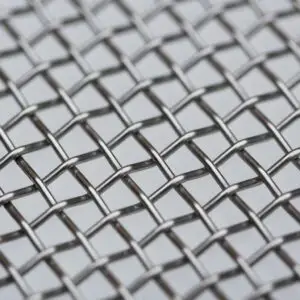
Yes, it is. It is manufactured on a similar type of machine as cotton cloth. The stainless steel wire is woven into a mesh using two wires. The wires run in two directions:
- The lengthwise wires are called the Warp Wire
- The width-wise wires are called the Weft Wire
5. What Are the Critical Factors When Specifying a Stainless Steel Woven Mesh?

Stainless Steel Woven Mesh has the following critical dimension:
- Aperture (A) – Distance between two adjacent wires
- Wire Diameter (D) – Thickness of the wire before weaving
- Mesh – Number of openings per liner inch
- SWG – Standard Wire Gauge
- % Open Area – The percentage of free area in the mesh
- Weave – This is how the wire is combined to make the mesh including Plain, Twill, Dutch
- Crimp – This is an additional process that is used to lock the wires together including Intermediate and Locking.
- Width – This is the width that the woven mesh is manufactured in
- Edge Finish – this is how the Width Wires are presented and can be Raw, Tucked and Selvage (Looped) edge
- Grade – This is the grade of Stainless Steel that is being used to make the Woven Mesh (304 and 316)
6. What is Mesh Count and SWG?
These are the terms that are historically used to describe woven mesh. They are:
- Mesh Count is the number of holes in the mesh per inch of mesh
- SWG is the Standard Wire Gauge that is used to describe the diameter of the wire
At SSWM we can take your Mesh count and SWG and we can supply you with a mesh that meets your specification
7. Are all Woven Meshes Made the Same?
No. There are many different types of Woven Mesh. These can vary according to the following:
- Different Wire Diameters for Warp and Weft Wire (Hollander Mesh)
- Different Weave patterns (Dutch, Reverse Dutch)
- Different Mechanisms to hold the Wires in place (Crimping)
8. What Does a Micron Measurement Mean For a Mesh?
Micron is a measurement of the Aperture. A micron is 1/1000 of a millimetre so a mesh that is 100 micron has an aperture of 0.1mm. It is difficult to compare Microns and mesh counts because different woven meshes have different wire diameters.
9. How is Woven Mesh Attached to Other Materials?
Woven Mesh can be attached to other equipment via several different methods:
- Welded to other steels
- Clamped to other materials
10. How Strong is Stainless Steel Woven Mesh?
Stainless Steel Woven Mesh strength is a function of the following:
- The Tensile strength of the Stainless Steel
- The Wire Diameter
- The Type of Weave
- The Number of wires
11. What is the Smallest Opening Mesh That We Supply?
We can supply a mesh with a wire diameter of 0.025mm and an aperture of 0.026mm. As a comparison, a human hair can be as small as 0.016mm, so our mesh is small.
This mesh is often used in Scientific labs at universities and research centres in the development of new processes. Because this mesh is so fine, it takes hours for the weaving machine to make this material. This mesh has 500 openings per inch, uses a 50 SWG wire and has an open area of 26%.
12. How Many Different Mesh Sizes Does SSWM Stock?
We carry over 100 different sizes of Woven Mesh and supply across all of Australia.

13. How is Stainless Steel Woven Mesh Shipped?
Because Stainless Steel Woven Mesh is woven, it can be easily rolled and wrapped. In most cases it can be sent via a courier when the weight is under 32Kgs and the width is less than 900mm.
With over 380 specifications in mesh sizes, our technical sales team are able to work with your specifications, including Mesh Count and SWG, to ensure you find the most appropriate solution for your project requirements.